A specialist lawyer and two senior investigators who have worked forced labour cases from the inside, translate the EU Forced Labour Regulation into the due diligence your company needs to build.
From April 2026 onwards, Intire organises a series of sessions on the EU Forced Labour Regulation, each focused on a specific element of the regulation. The series opens on 21 April.
On 14 December 2027, the regulation enters into application. It applies to every sector, every supply chain tier, every company size. An estimated 27.6 million people are in forced labour situations globally. Risk spans textiles, agriculture, electronics, pharmaceuticals and beyond.
Knowing the law is only the starting point. Enforcement mirrors the investigative methodologies used in modern slavery cases. Your due diligence must speak the same language as investigators.
This series equips you to understand not just what the law requires, but how enforcement works and what your documentation must demonstrate.
More information about the full programme can be found at the bottom of this page.
Trainers

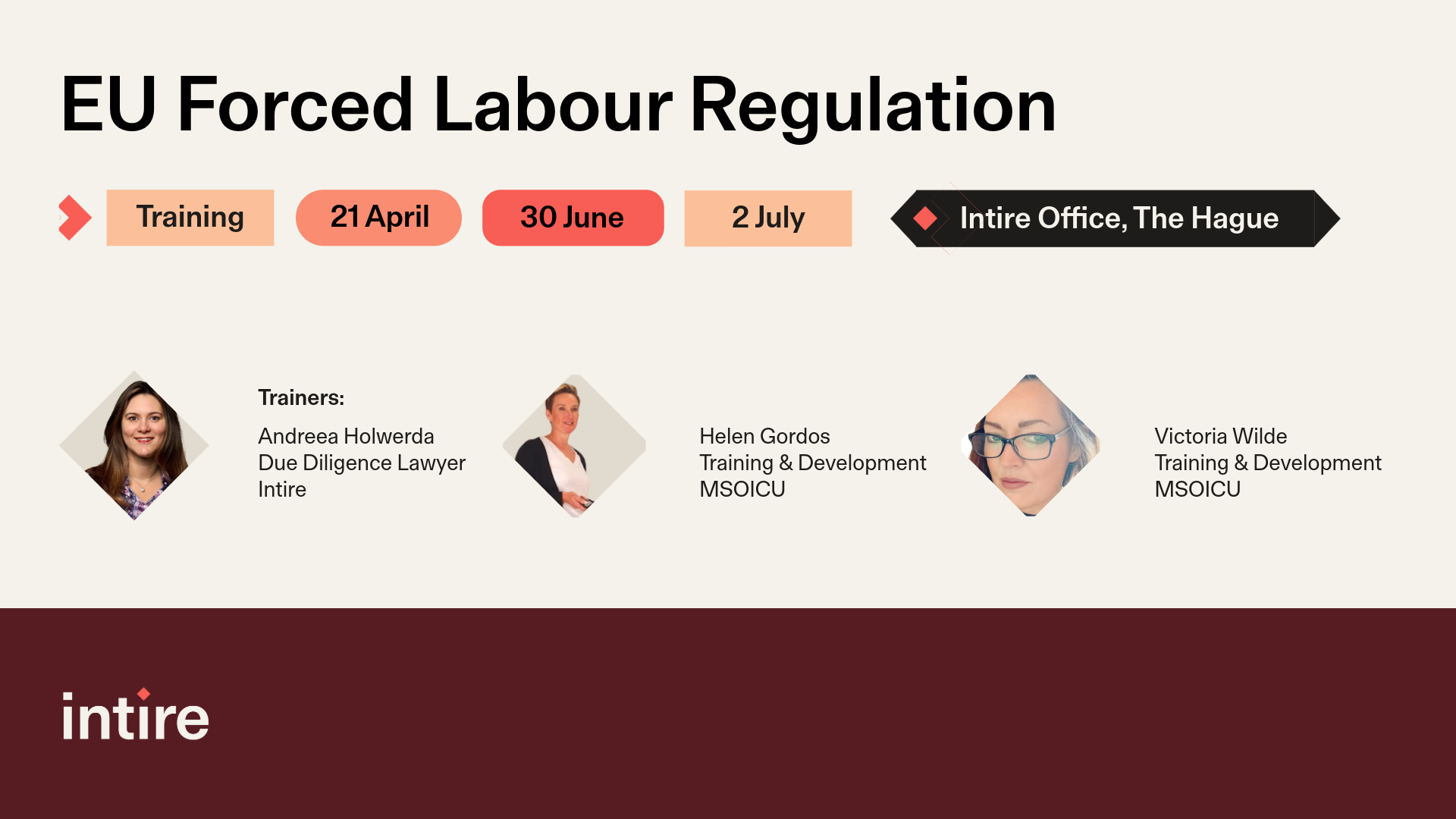
Andreea Holwerda-Gavrila | Human Rights and Due Diligence Lawyer at Intire
Andreea has over 15 years of international experience, with a focus on legal sustainability standards such as the UNGPs, OECD Guidelines, EU Taxonomy, EU Forced Labour Regulation, EU Pay Transparency Directive, EU AI Regulation and other relevant legislation. She holds an LLM in Law & Technology and an LLM in International & EU Law, and is admitted to the Bar of England and Wales.

Helen Gordos | Training & Development Specialist at MSOICU
With over 30 years in law enforcement and more than 12 specialising in modern slavery,
Helen is a former Tactical Advisor to the National Crime Agency with operational experienceacross Europe, Nigeria and Indonesia. A recipient of multiple Chief Constable Commendations and a qualified Learning & Development professional, she brings
exceptional investigative and strategic depth to questions of supply chain exploitation.

Victoria Wilde | Training & Development Specialist at MSOICU
Victoria has 28 years in law enforcement, with over 6 specialising in modern slavery and human trafficking. A former National Interview Advisor for the National Crime Agency, she led victim engagement and has represented the UK on best practice in victim engagement at the United Nations in Vienna. She contributes to European law enforcement training through CEPOL and, in 2025, delivered capacity-building workshops to ten countries across the
ASEANAPOL network.
Programme
Morning — The Legal Framework (Andreea Holwerda-Gavrila, Human Rights and Due Diligence Lawyer)
- Understanding scope, timeline and obligations under the EU FLR and the impact of the Forced Labour Regulation on your business;
- Defining forced labour and state-imposed forced labour;
- Due diligence: what companies must demonstrate and when.
Afternoon — The Investigator’s Lens (Helen Gordos and Victoria Wilde, National Policing Modern Slavery & Organised Immigration Crime Unit (MSOICU)
- How law enforcement investigates forced labour;
- What evidence your company needs to hold
- Case studies from UK and international investigations
- Why worker voice is your most powerful early warning system
- Practical exercise
Key Takeaways
- An actionable understanding of your obligations under the EU FLR
- Direct insight into what investigators look for and how your documentation will be assessed
- Practical tools and resources to build or strengthen your forced labour compliance programme
Details
Date: 21 April, 2026
Time: 9:00–16:00 (lunch included)
Fee: €960
Location: Intire Office, The Hague
Training Overview
Please note: the language of instruction during all sessions is English.
EU Forced Labour Regulation: The Law’s Requirement, the Investigator’s Lens | 21 April
A specialist lawyer and two senior investigators who have worked forced labour cases from the inside, translate the EU Forced Labour Regulation into the due diligence your company needs to build.
On 14 December 2027, EU Forced Labour Regulation (EUFLR) enters into application. EUFLR is a binding prohibition on placing, making available, or exporting any product made with forced labour on the EU market. This is hard law. It applies to every economic operator, every sector, every tier of the supply chain.
The scale of exposure is significant. The Regulation’s own recitals cite an estimated 27.6 million people in forced labour situations in 2021. Risk spans textiles, agriculture, solar panels electronics, pharmaceuticals and beyond. Research commissioned by the Dutch Ministry of Foreign Affairs (February 2025) identified thirty high-to-very-high-risk product categories imported into the Netherlands alone, and flagged two of its top five import partners, the United States and China, as high and very high risk respectively.
Knowing the law is only the starting point. The EU FLR’s enforcement architecture: competent authority investigations, customs controls, due diligence scrutiny, mirrors the investigative methodologies used in modern slavery and labour exploitation cases. The ILO’s 2025 revised forced labour indicators are the operational lens through which investigators will assess your supply chain. Your due diligence must speak that same language.
Morning — The Legal Framework (Andreea Holwerda-Gavrila, Human Rights and Due Diligence Lawyer)
- Understanding scope, timeline and obligations under the EU FLR and the impact of the Forced Labour Regulation on your business;
- Defining forced labour and state-imposed forced labour;
- Due diligence: what companies must demonstrate and when.
Afternoon — The Investigator’s Lens (Helen Gordos and Victoria Wilde, National Policing Modern Slavery & Organised Immigration Crime Unit (MSOICU)
- How law enforcement investigates forced labour;
- What evidence your company needs to hold
- Case studies from UK and international investigations
- Why worker voice is your most powerful early warning system
- Practical exercise
Key Takeaways
- Practical tools and resources to build or strengthen your forced labour compliance programme
- An actionable understanding of your obligations under the EU FLR
- Direct insight into what investigators look for and how your documentation will be assessed
Date: 21 April, 2026
Time: 9:00–16:00 (lunch included)
Fee: €960
Location: Intire Office, The Hague
Deep Dive 1: The How of Grievance Mechanisms | 30 June 2026
New European legislation makes grievance mechanisms and remediation processes no longer optional. With the EU Forced Labour Regulation and stricter due diligence requirements, organisations must have robust grievance mechanisms in place to identify risks in the value chain at an early stage and prevent sanctions or reputational damage.
In this intensive half-day training, you will learn how to design and operate effective grievance mechanisms that meet international standards and European legislation. Topics include accessibility for vulnerable groups, governance, confidentiality, appropriate remediation and measuring effectiveness.
What you’ll walk away with:
- Practical approaches and decision-making guidance for engaging stakeholders from the outset, ensuring accessibility across diverse contexts, and criteria for determining proportionate remedies across different impact scenarios
- Better understanding of regulatory expectations across key frameworks, particularly the EU Forced Labour Regulation’s due diligence requirements, and how to design mechanisms Wthat satisfy compliance requirements whilst remaining accessible and trusted by affected stakeholders
- Structured Tools and reference materials you can adapt for your operational context
Date: 30 June, 2026
Time: 9:30–13:30
Fee: €600
Location: Initre Office, The Hague
Who should attend: This training is particularly valuable for sustainability managers, compliance officers, human resources professionals, supply chain managers, operations managers, and anyone responsible for establishing or overseeing grievance mechanisms and remedy processes within your company.
Deep Dive 2: ILO and other indicators on forced labour | 2 July
This training equips compliance, procurement, legal and sustainability teams with the
knowledge and tools to identify forced labour risks using the revised ILO indicators and to
meet the due diligence requirements of the EU Forced Labour Regulation and related
legislation, including the Corporate Sustainability Due Diligence Directive (CS3D).
The 2025 revised ILO indicators introduce important updates, including a dedicated section
on state-imposed forced labour, covering labour transfer schemes targeting ethnic or
religious minorities, compulsory work as political punishment, and the abuse of exceptions
such as prison labour.
After this session you will leave able to:
- Apply the 11 revised ILO indicators to real supply chain and procurement scenarios
- Recognise state-imposed forced labour and the evidentiary challenges it presents
- Map compliance gaps and propose practical remediation and supplier engagement
- measures
- Prepare for regulatory scrutiny ahead of the December 2027 enforcement date
Date: 2 July, 2026
Time: 9:00–13:00
Fee: €600
Who should attend: This event is designed for professionals working in procurement, supplier management, legal, compliance, risk, sustainability, ESG, HR, audit, and internal controls. Senior leaders and board members with supply chain governance responsibility are also warmly welcomed.
Deep Dive 3: Going through the EU Guidelines on EUFLR | 2 July
The European Commission is expected to publish official guidance on the EU Forced Labour Regulation (FLR) in June 2026, setting out how enforcement authorities will assess forced labour risks, what constitutes a ‘substantiated concern’, and how the FLR interacts with existing due diligence frameworks. This guidance will be a critical reference document for companies across all sectors and supply chains.
This three-hour deep dive, delivered two weeks after publication, provides a structured
analysis of the Commission’s guidelines, translating regulatory language into actionable
compliance steps for your company. With limited time between the guidance publication
(June 2026) and full enforcement (December 2027), this session is designed for companies that wish to operationalise the guidance without delay.
After this session you will leave able to:
- Take concrete steps toward meeting FLR obligations ahead of the enforcement date
- Apply the key provisions of the EC guidance within your organisation
- Understand how it connects to CS3D, ILO indicators, and other compliance frameworks
- Use the EU risk database to prioritise due diligence efforts
- Identify gaps between current practice and the compliance standard
- Know what to communicate to suppliers and how to document your due diligence trail
Date: 2 July, 2026
Time: 13:30 – 16:30
Fee: €490
Who should attend: professionals working in legal, compliance, risk, procurement, or supplier management. Those responsible for sustainability, ESG, or corporate responsibility will find direct value, as will audit and internal control teams. Senior leaders with supply chain governance responsibility are also encouraged to attend.
Price per session
- EU Forced Labour Regulation: The Law’s Requirement, the Investigator’s Lens | 21 April | €960
- Deep Dive 1: The How of Grievance Mechanisms | 30 June 2026 | €600
- Deep Dive 2: ILO and other indicators on forced labour | 2 July | €600
- Deep Dive 3: Going through the EU Guidelines on EUFLR | 2 July | €490
Combi deals
- All 4 sessions: €2,250 per participant (Save €400 | Regular price: €2,650)
- Gain EUFLR expertise while reducing your investment by 15%.
Multiple participants from the same company save more
- 2-4 people: 10% discount on any package
- 5+ people: Have a look at our customized in-house training solutions or contact us for a personalised offer
- For other combinations or multiple participants from the same organisation, please contact us.
In special circumstances we can accommodate people to join online. These trainings are also available in-company. Please contact us if you are interested.